AgriFlyAI: An Autonomous UAV System Powered by an Enhanced YOLOv8-Based Edge AI Model for Real-Time Strawberry Detection and Crop Monitoring
Application of autonomous Unmanned Aerial Vehicle (UAV) systems and the use of artificial intelligence in precision agriculture are increasing and are important tools for better crop monitoring, …
الفريق
فريق الذكاء الطائر
رمز الفريق
NURAI2026-0199
المشرف
د. سلامة ادريس مصطفى نجم
قراءة الوصف الكامل للمشروع
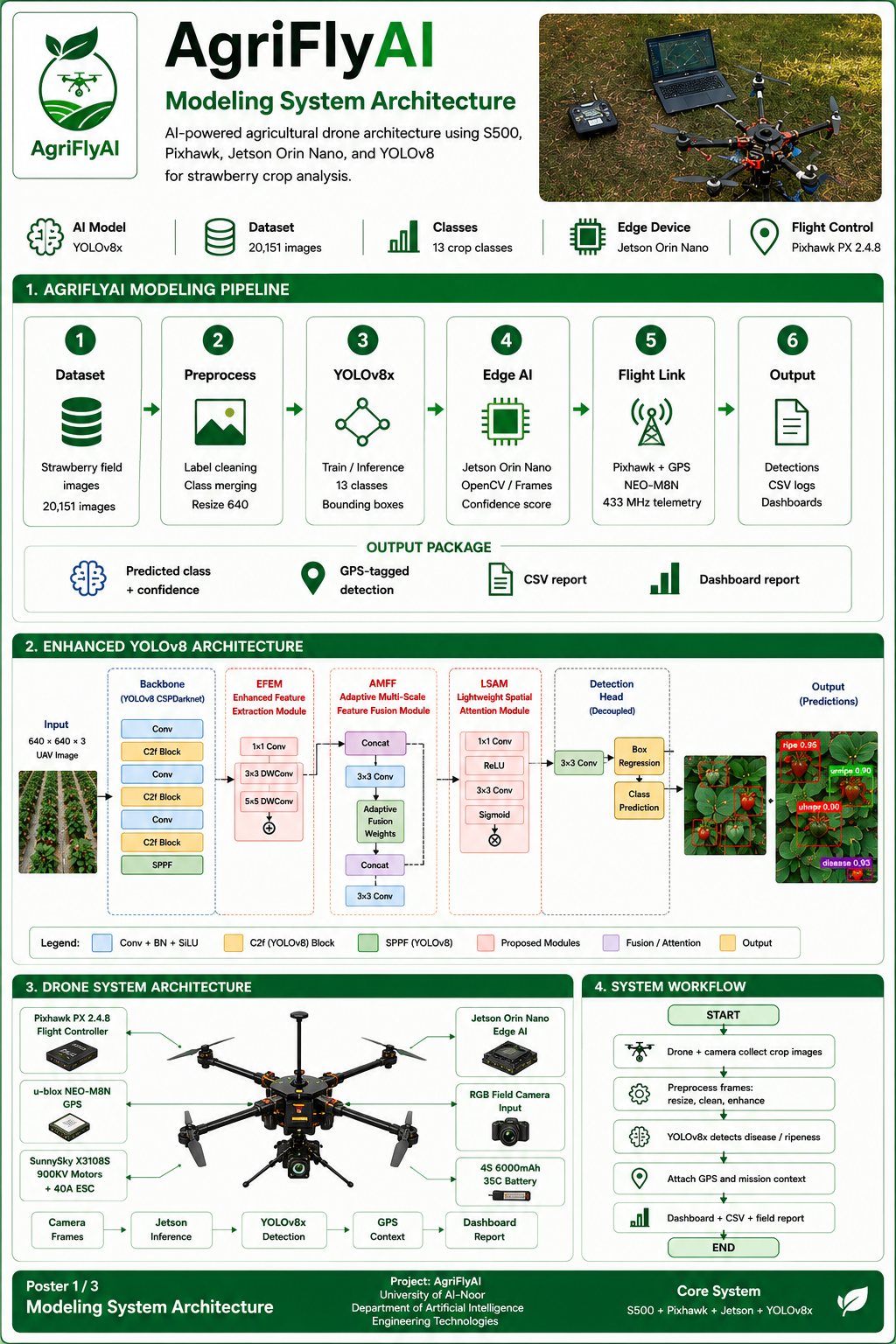
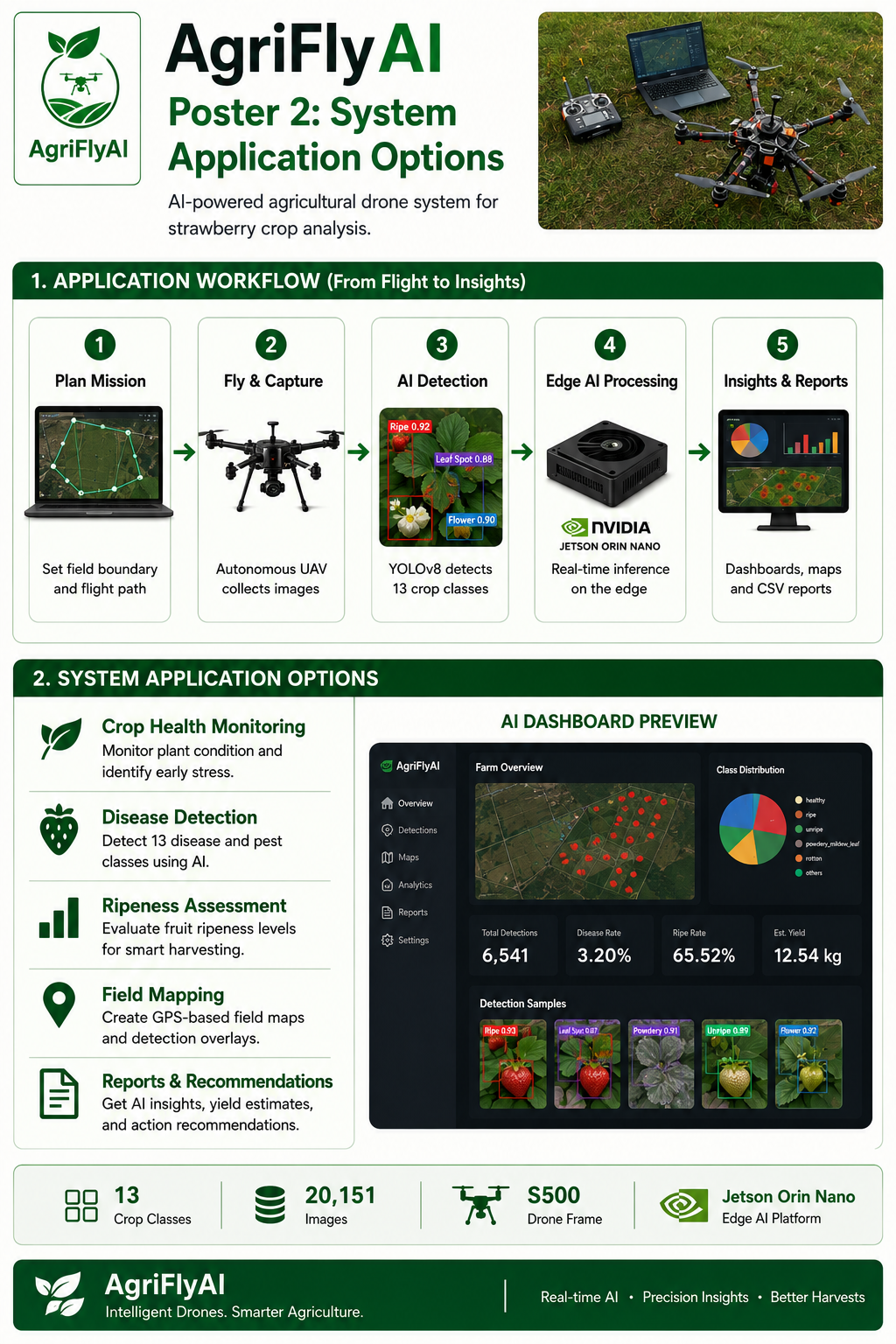
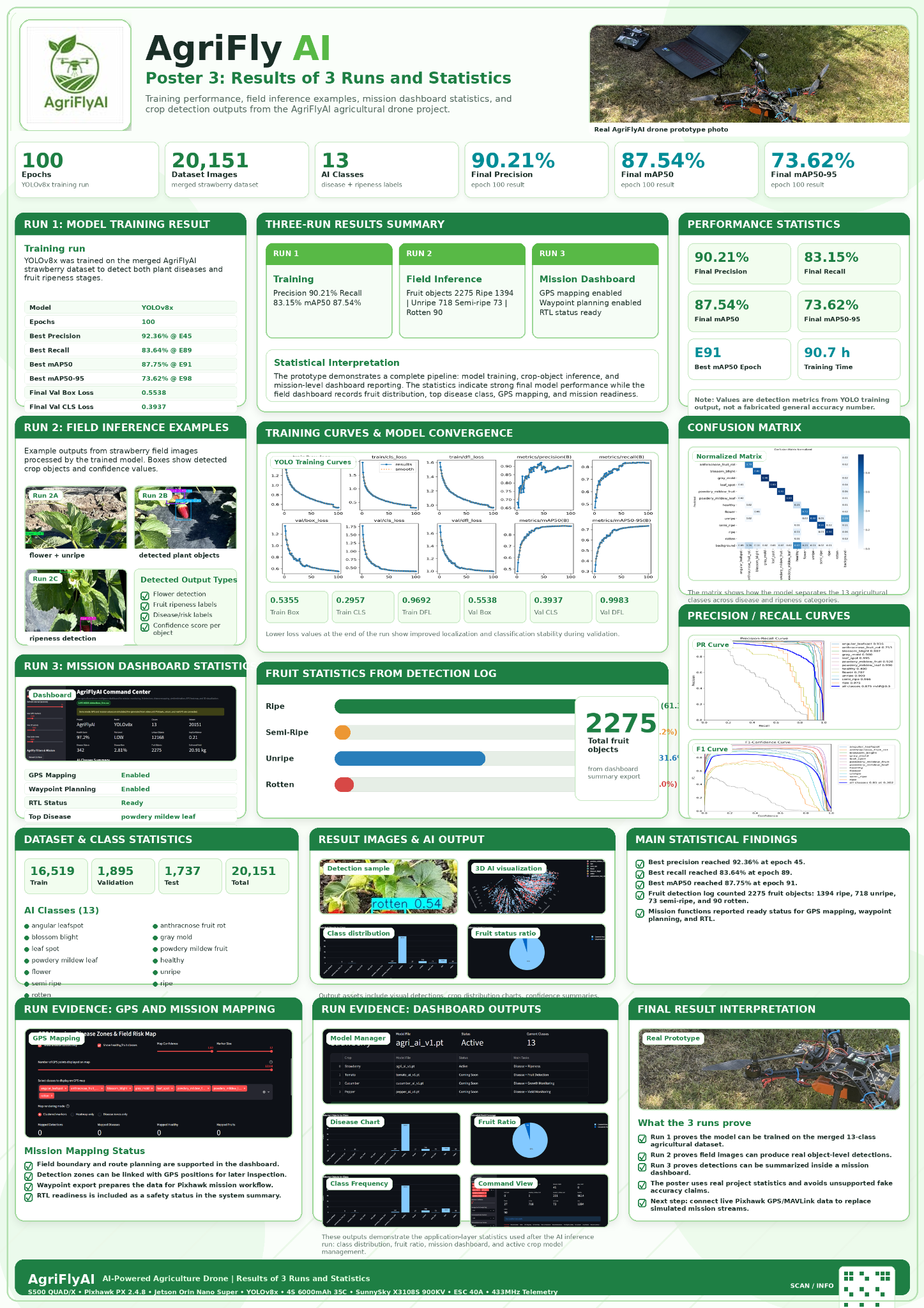
Application of autonomous Unmanned Aerial Vehicle (UAV) systems and the use of artificial intelligence in precision agriculture are increasing and are important tools for better crop monitoring, reduction of human labor, and enhancement of agricultural productivity. Although the above-mentioned challenges exist, real-time strawberry detection is still difficult under different illumination or unseen fruits and complicated backgrounds. This paper presents an edge artificial intelligence (AI) model improved by using the YOLOv8 model to detect strawberries and monitor them in real time, and introduces an autonomous unmanned aerial vehicle (UAV) system for strawberry monitoring. The model to be used is optimized for the YOLOv8 model, with the addition of edge computing on an NVIDIA Jetson Orin Nano, autonomous flight control using a Pixhawk controller, and an intelligent dashboard for flight mission planning and crop analysis. To meet the requirement of detecting strawberry ripeness stages, plant health conditions, and common diseases under complex field environments, it is proposed that feature extraction methods be strengthened to generate better feature representations, multi-scale feature fusion methods be adopted to fuse the information from different scales, and lightweight attention mechanisms be introduced to achieve effective detection. The model was trained on more than 20,000 annotated images from 12 classes and tested based on the Precision, Recall, and mean Average Precision (mAP) metrics. Results from this experiment showed 90% Precision, 83% Recall, 88% mAP@50, and 74% mAP@50-95, with real-time inference at around 9 fps on Jetson Orin Nano, with no dependency on the cloud. The full AgriFlyAI suite also produces crop health analysis, disease hotspot maps, and crop yield predictions to aid data-informed farming decisions. The outcomes prove that the suggested model is an efficient, scalable, and practice-oriented solution to the problem of intelligent UAV-based precision agriculture.
المسار الطبي
AI-powered smart monitoring system
يتناول هذا المشروع تحديًا هامًا في مجال الرعاية الصحية الذكية والمراقبة الطبية، حيث تفتقر أنظمة مراقبة المرضى التقليدية غالبًا إلى التكامل الذكي للبيانات، والتحليل الفوري، ودعم اتخاذ القرارات الس…
الفريق
TRM
رمز الفريق
NURAI2026-0189
المشرف
م.م. أحمد جمال محمد
قراءة الوصف الكامل للمشروع
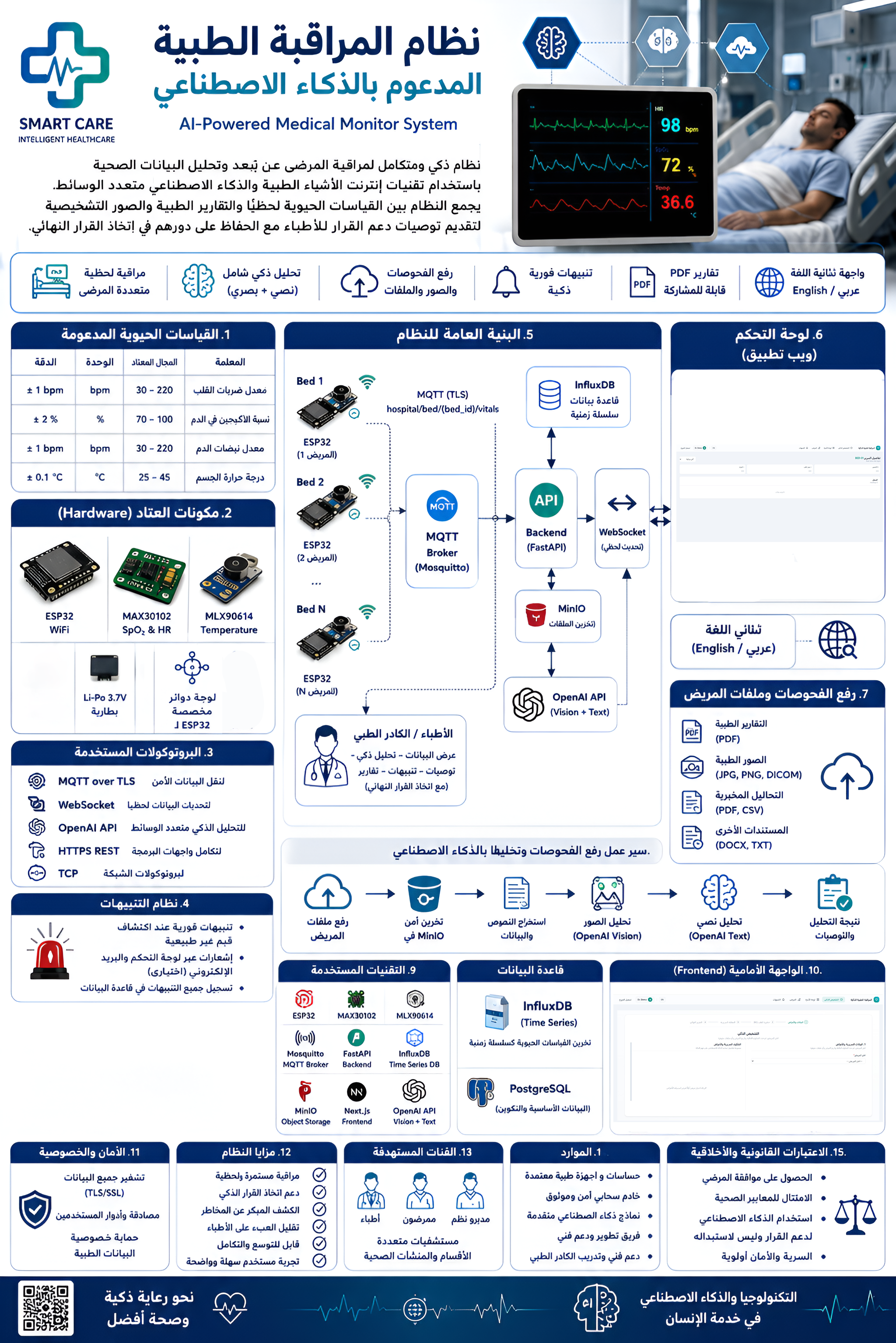
يتناول هذا المشروع تحديًا هامًا في مجال الرعاية الصحية الذكية والمراقبة الطبية، حيث تفتقر أنظمة مراقبة المرضى التقليدية غالبًا إلى التكامل الذكي للبيانات، والتحليل الفوري، ودعم اتخاذ القرارات السريرية الشاملة. يعتمد الحل المقترح على دمج إنترنت الأشياء الطبية (IoMT)، والحوسبة السحابية، والذكاء الاصطناعي متعدد الوسائط، لتطوير منصة مراقبة طبية ذكية قادرة على جمع العلامات الحيوية للمرضى بشكل مستمر وتحليلها جنبًا إلى جنب مع تقارير المختبر، والوثائق الطبية، والصور التشخيصية.
يستخدم النظام وحدات تحكم دقيقة ESP32 مزودة بمستشعرات حيوية لقياس معدل ضربات القلب، ونسبة تشبع الأكسجين في الدم (SpO₂)، ودرجة حرارة الجسم. تُنقل البيانات المجمعة بشكل آمن باستخدام بروتوكول MQTT إلى خادم سحابي، حيث تُخزن، وتُعرض من خلال لوحة تحكم ثنائية اللغة على الويب، وتُعالج باستخدام نماذج الذكاء الاصطناعي متعددة الوسائط من OpenAI لتوليد توصيات سريرية ذكية.
يتناول هذا المشروع تحديًا هامًا في مجال الرعاية الصحية الذكية والمراقبة الطبية، حيث تفتقر أنظمة مراقبة المرضى التقليدية إلى التكامل الذكي للبيانات، والتحليل الفوري، ودعم اتخاذ القرارات السريرية الشاملة. يهدف هذا المشروع بشكل أساسي إلى تحسين سلامة المرضى من خلال تمكين المراقبة المستمرة في الوقت الفعلي، والكشف المبكر عن الحالات الصحية غير الطبيعية، ودعم اتخاذ القرارات السريرية بمساعدة الذكاء الاصطناعي، مع الحفاظ على دور الأطباء كصانعي القرار النهائيين. تشمل النتائج المتوقعة تعزيز كفاءة الرعاية الصحية، وتقليل عبء العمل على الطاقم الطبي، وتسريع الاستجابة لحالات الطوارئ، وتحسين الدعم التشخيصي، وتقديم حلول رعاية صحية ذكية قابلة للتطوير، مناسبة للتطبيق في المستشفيات الحديثة وبيئات الرعاية الصحية الرقمية المستقبلية.
المسار الطبي
MedCoreAI: An Explainable Deep Learning Model Based on an Enhanced SqueezeNet with Grad-CAM for Multi-Class Spinal MRI Diagnosis
Accurate and explainable diagnosis of spinal disorders from magnetic resonance imaging (MRI) remains a significant challenge due to the complex anatomy, variability in pathological manifestations…
الفريق
MedCore AI
رمز الفريق
NURAI2026-0198
المشرف
د. سلامة ادريس مصطفى نجم
قراءة الوصف الكامل للمشروع
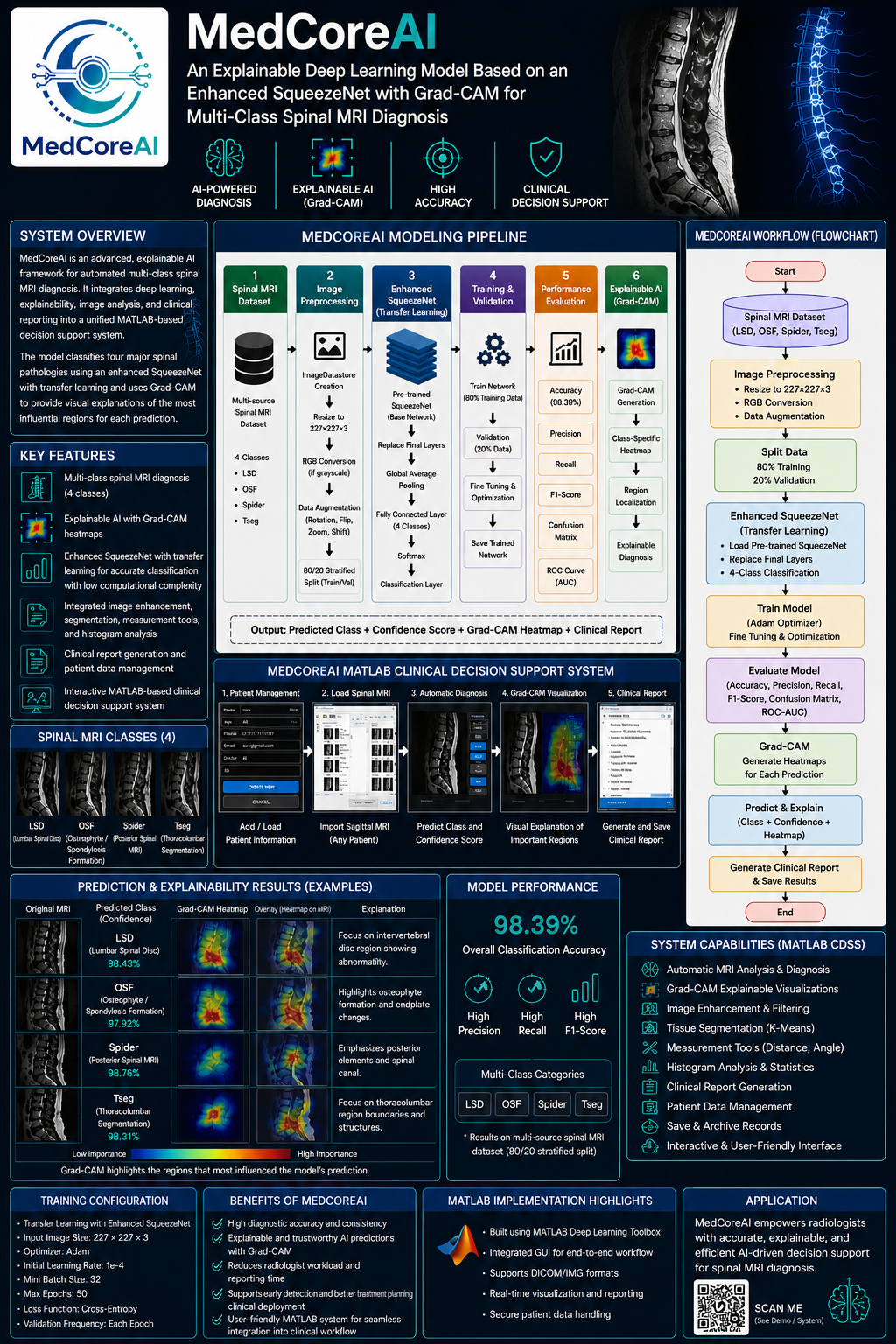
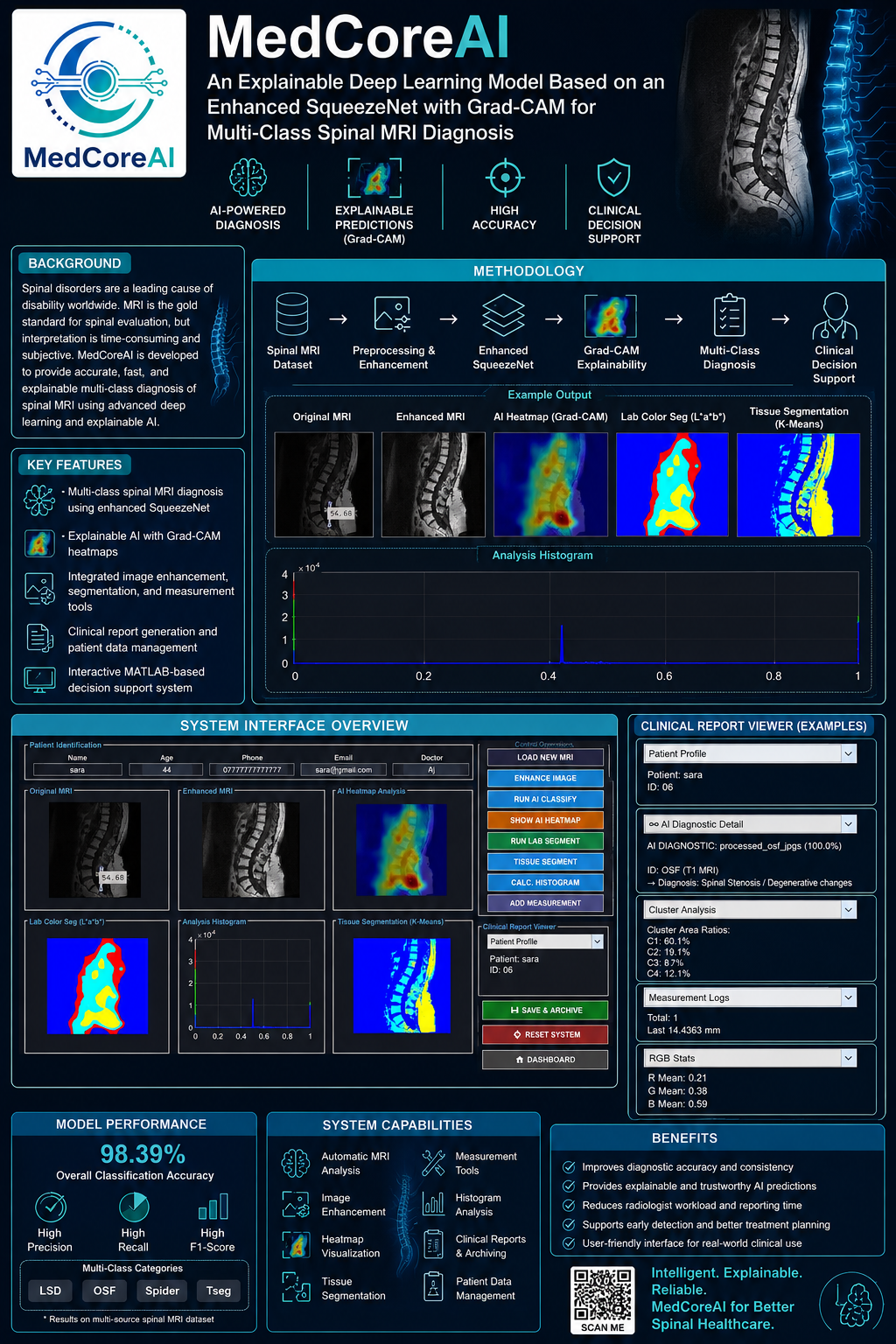
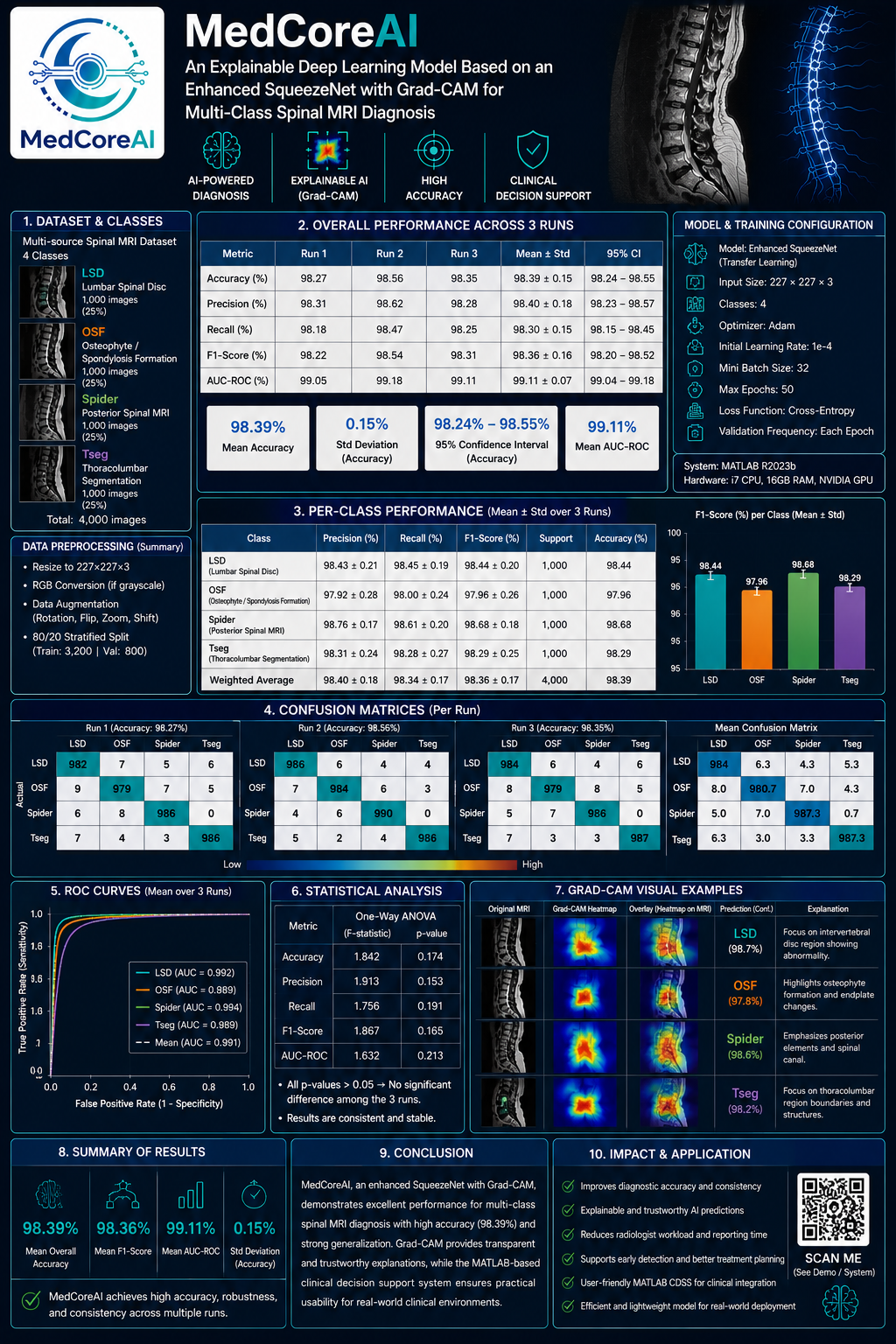
Accurate and explainable diagnosis of spinal disorders from magnetic resonance imaging (MRI) remains a significant challenge due to the complex anatomy, variability in pathological manifestations, and the limited interpretability of conventional deep learning models. This paper proposes MedCoreAI, an explainable deep learning model for multi-class spinal MRI diagnosis based on an enhanced SqueezeNet architecture with Gradient-weighted Class Activation Mapping (Grad-CAM). The proposed model employs transfer learning to adapt a lightweight SqueezeNet model to classify four spinal pathology categories while maintaining low computational complexity suitable for clinical deployment. To enhance the model's transparency, Grad-CAM provides class-specific visual explanations and highlights the image region most diagnostically important for the prediction, helping the clinician interpret and validate the model's predictions. An 80:20 stratified split was used to train and validate the model on the multi-source spinal MRI dataset. The experimental results show that the proposed model achieves a high overall classification accuracy of 98.39%, with high precision, recall, and F1-score for each pathology class considered, demonstrating its robustness and effectiveness. To enable practical clinical application, the trained model was implemented in an interactive MATLAB-based decision support system that supports automatic MRI analysis, explanation, image enhancement, measurement, and patient data management. The results of the experiments suggest that MedCoreAI can provide a reliable, efficient, and interpretable computer-aided diagnosis solution for spinal MRI diseases, which could be beneficial for clinical decision-making in real-world clinical settings.
مسار التربية والتعليم
Nibras: An Intelligent Iraqi Educational Robot for Learning, Emotional Wellbeing Monitoring, and Parent-Assisted Student Support Using Computer Vision and Conversational AI
University students in Iraq face significant gaps in culturally specific educational and emotional support. This project introduces Nibras, an open-source, low-cost (US$31) intelligent robot depl…
الفريق
NGX
رمز الفريق
NURAI2026-0200
المشرف
م. م. سدرة علي الصغير محمد
قراءة الوصف الكامل للمشروع
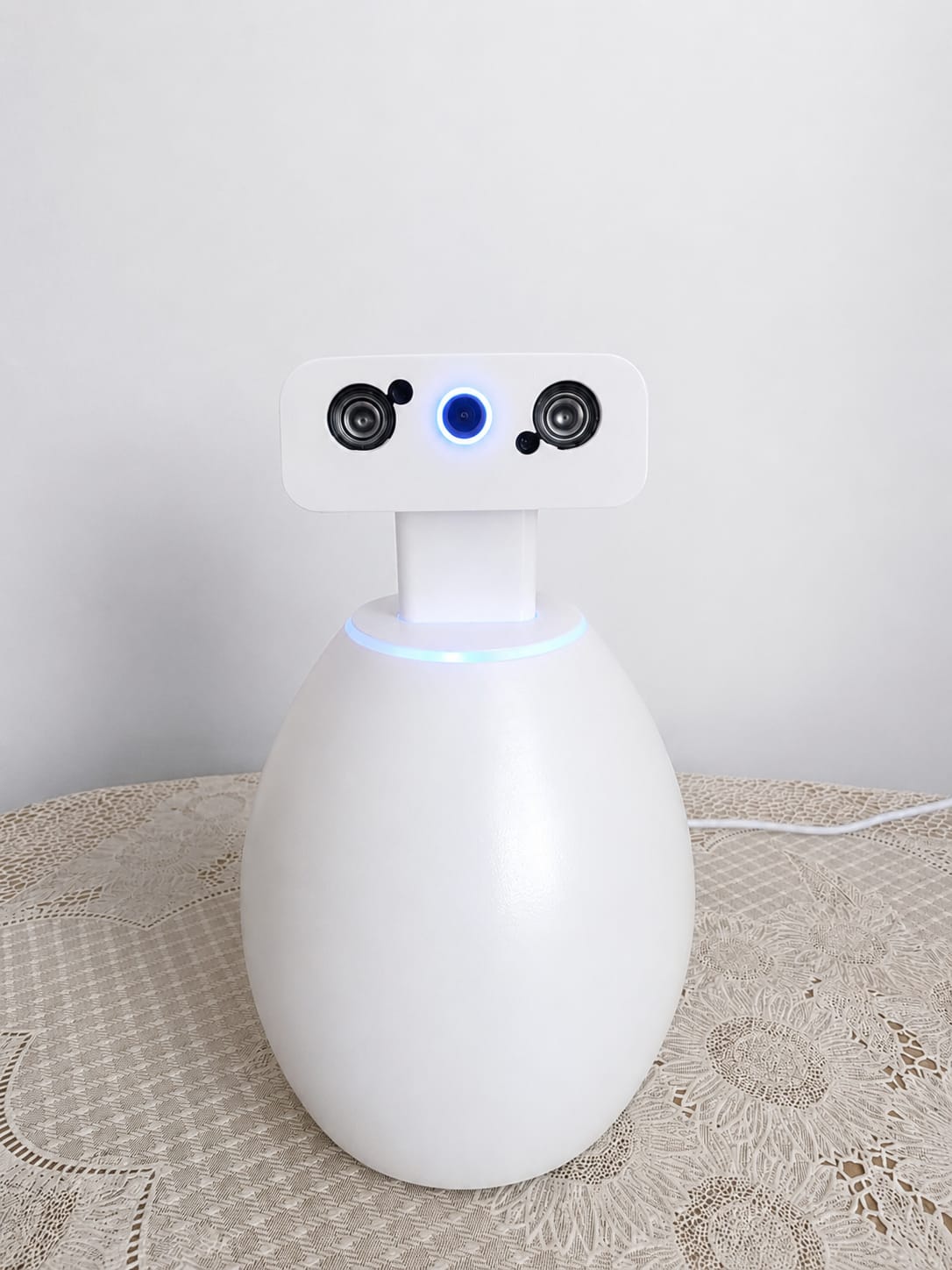
University students in Iraq face significant gaps in culturally specific educational and emotional support. This project introduces Nibras, an open-source, low-cost (US$31) intelligent robot deployed on a Raspberry Pi 4. Unlike generic AI, Nibras integrates a Claude Haiku 4.5 language model with a specialized computer vision pipeline to estimate emotional cues such as stress and fatigue. Using a voice-first interface, it communicates in native Iraqi Arabic, providing tutoring and emotional wellbeing support. A parent dashboard provides daily summarized reports on mood trends and engagement without compromising student privacy through local-only processing. Testing across 150 cases demonstrates high accuracy in dialect preservation (96%) and crisis detection (100%), proving that sophisticated, hardware-integrated AI can be accessible and culturally resonant.
Keywords: Artificial intelligence, AI, computer vision, Iraqi dialect, emotional well-being.
المسار الزراعي
Real-Time Agricultural Field Monitoring Robot with Plant Health Analysis
This project addresses a significant problem in modern agriculture, specifically the lack of real-time, autonomous systems for monitoring crop health and environmental conditions in field environ…
الفريق
فريق الذكاء
رمز الفريق
NURAI2026-0191
المشرف
م.م. كرم سمير عبداللطيف
قراءة الوصف الكامل للمشروع
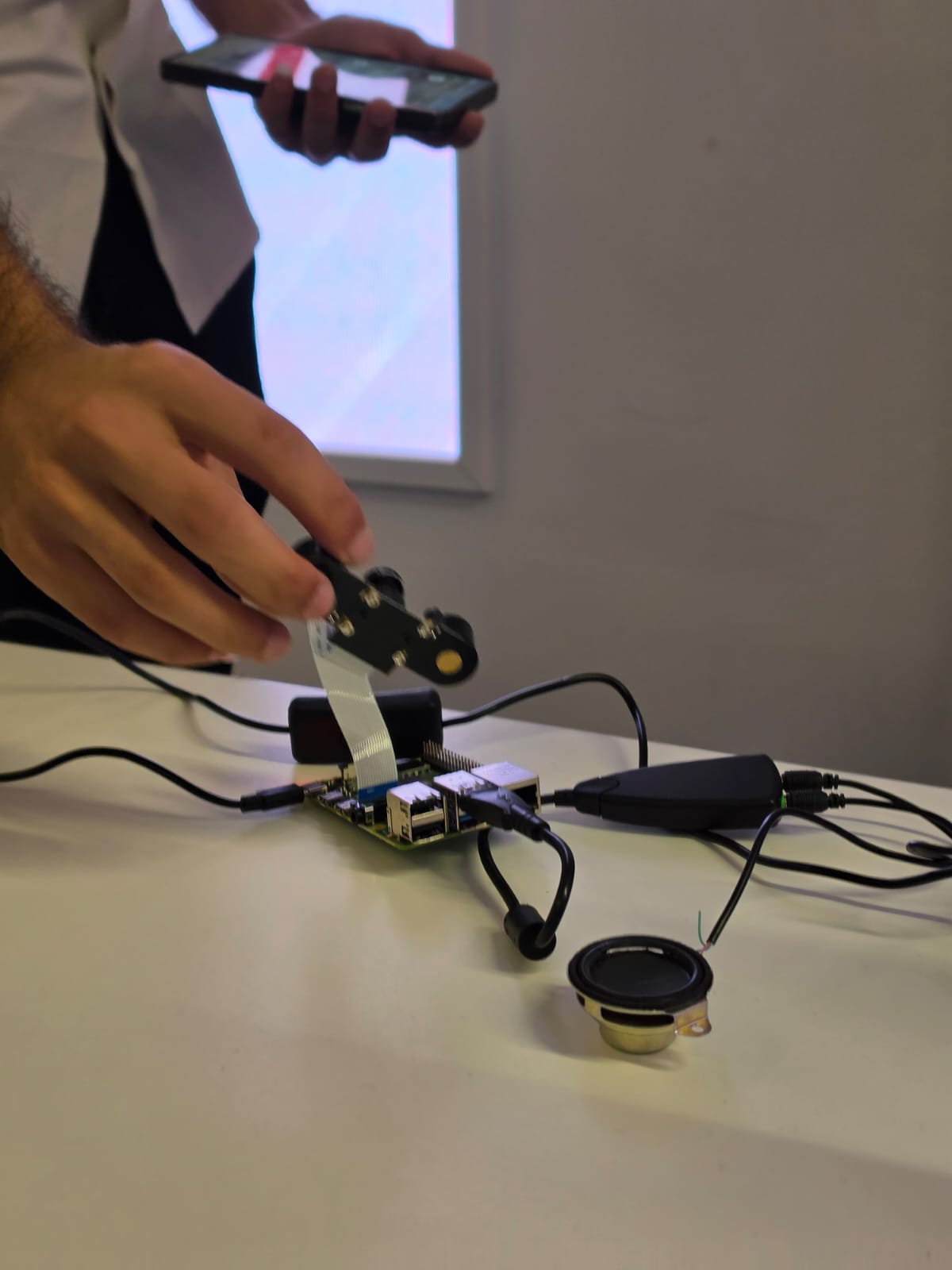
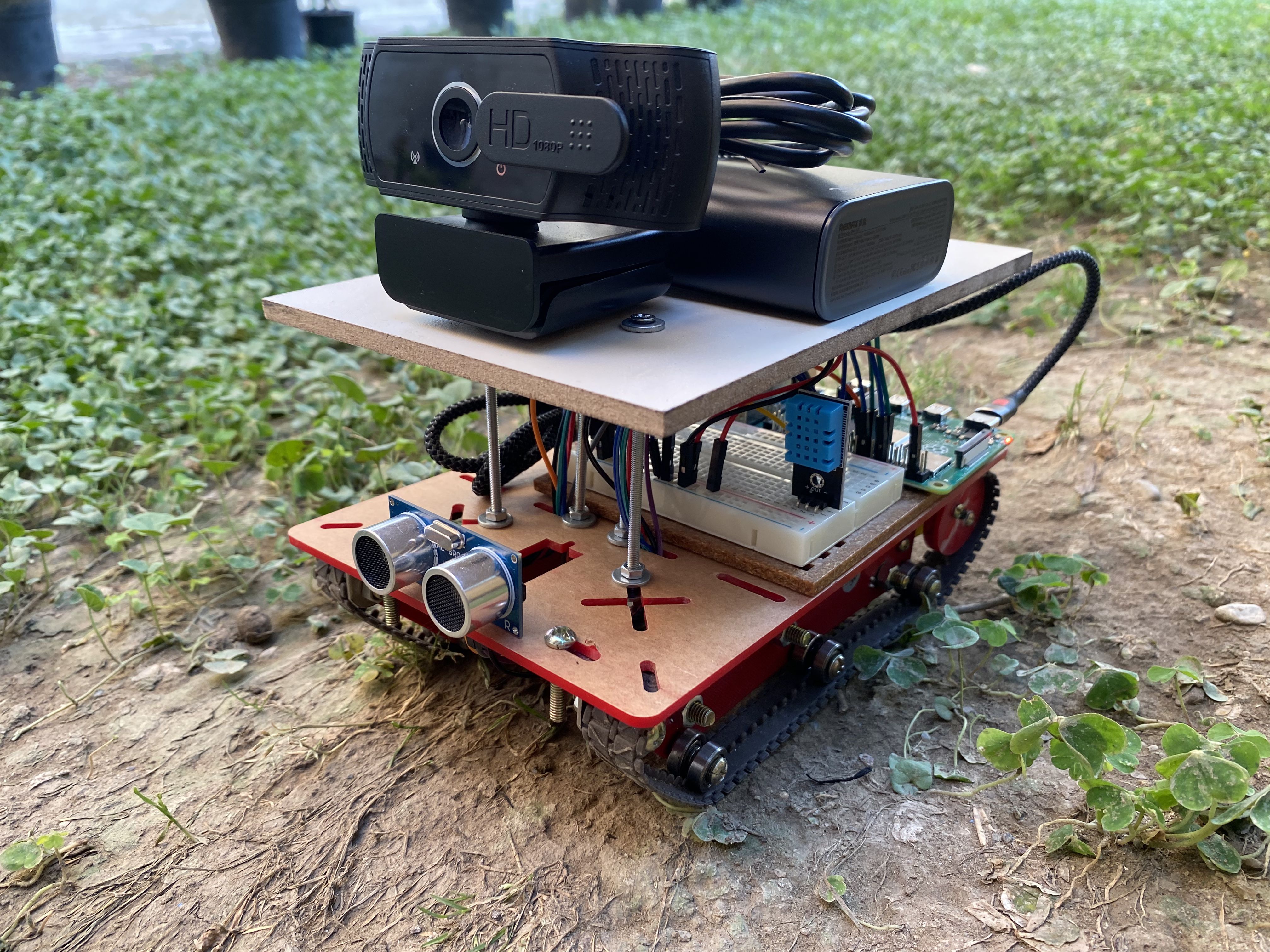
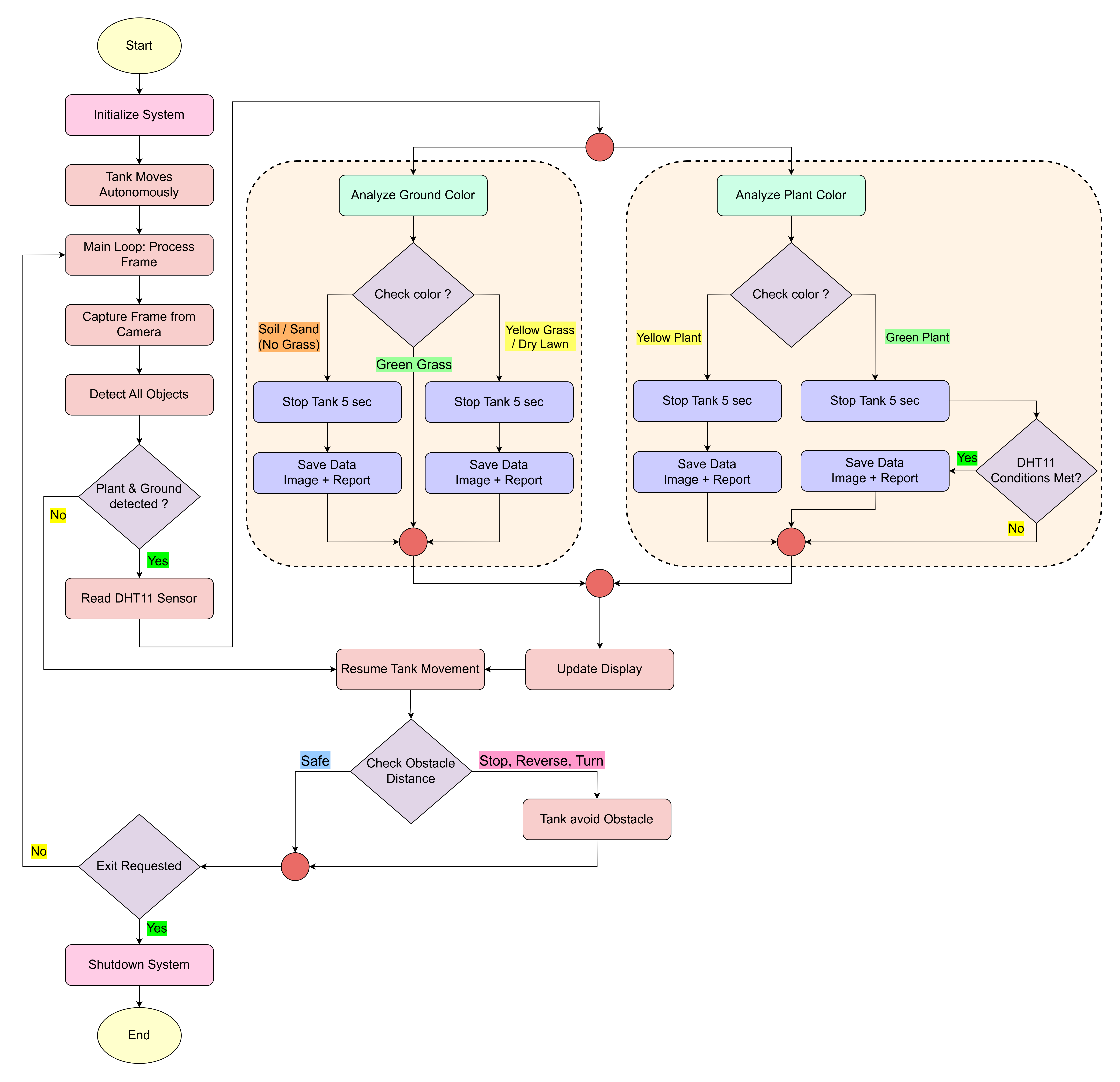
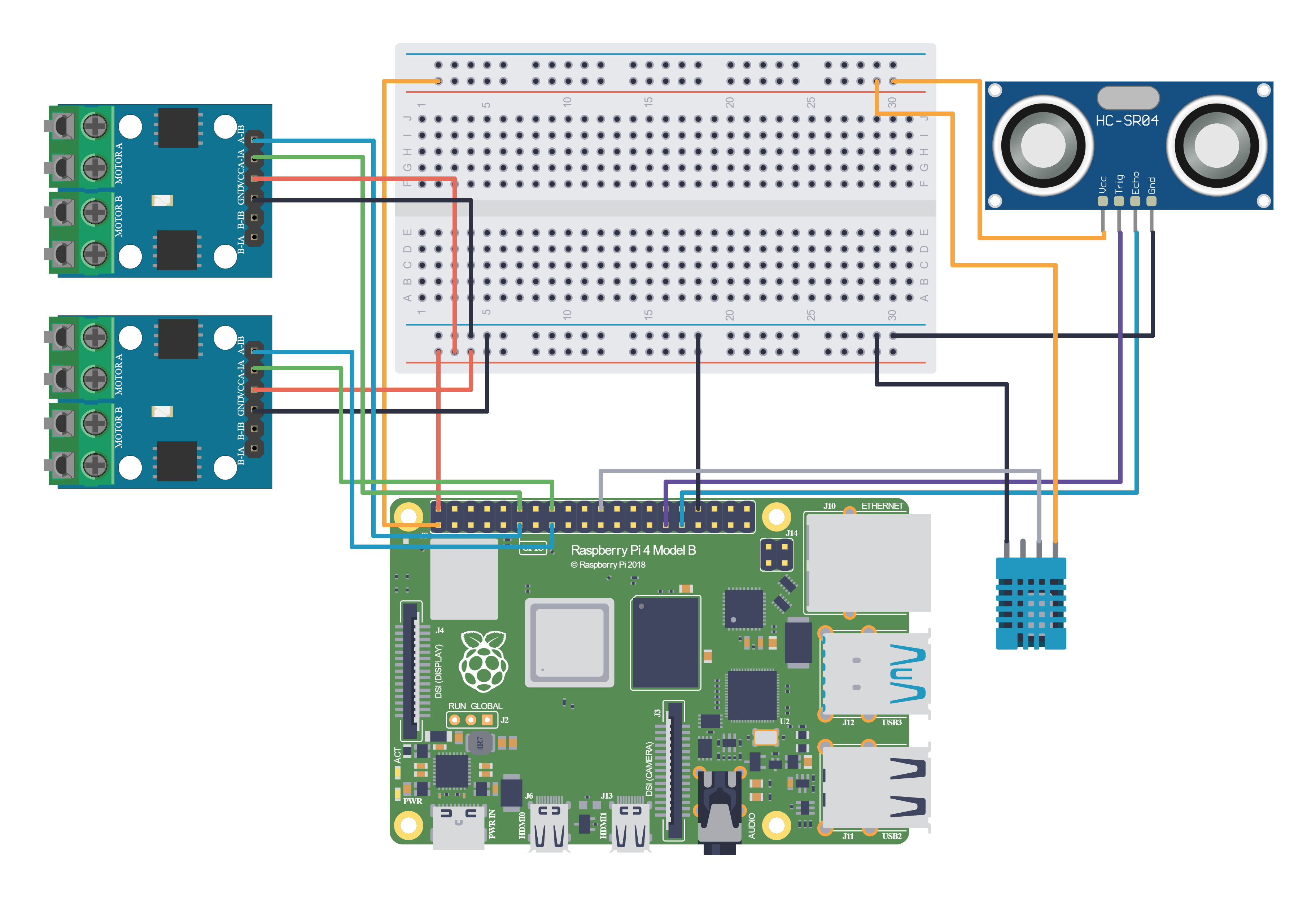
This project addresses a significant problem in modern agriculture, specifically the lack of real-time, autonomous systems for monitoring crop health and environmental conditions in field environments. The proposed solution is based on the integration of computer vision, deep learning, and sensor technologies deployed on a Raspberry Pi 4-powered robotic platform. The system utilizes a USB camera with the SSD MobileNet V3 object detection model for real-time identification of plants and ground conditions, while simultaneously collecting environmental data including temperature and humidity. The tank-like robot navigates autonomously using obstacle avoidance, and upon detecting specific conditions (green plants, yellow plants, dry grass, or soil/sand), it captures images and logs comprehensive sensor data. The expected outcomes include improved crop monitoring efficiency, automated data collection for precision agriculture, and reduced labor requirements for field surveillance.
NURAI · 2026
مسار خدمة المجتمع
Robocar Control System Based on Speech Recognition Techniques
This project addresses a significant problem in the field of speech recognition that deals with recognizing the uttered speech syllable and accommodate it to control the movement of a robocar. Th…
الفريق
Prototype 0101
رمز الفريق
NURAI2026-0194
المشرف
د. مازن رجب خليل
قراءة الوصف الكامل للمشروع
This project addresses a significant problem in the field of speech recognition that deals with recognizing the uttered speech syllable and accommodate it to control the movement of a robocar. The proposed solution is based on analyzing the speech signal using discrete wavelet packet decomposition for seven levels spectrum that is introduced as the input vector to a convolutional neural network in a python language media. Natural language processing techniques was used to improve the recognition capability of the system. The proposed recognition system is applied on a robocar to control its movement, with the aim of creating a sample for handicapped chair that can be controlled by spoken orders. The system correct accepting ratio (CAR) exceeded 97% , while the correct rejection ratio is 100%.
NURAI · 2026
المسار الزراعي
Smart AI – Powered Farm Monitoring & Control System
تواجه الزراعة الحديثة العديد من التحديات، منها هدر المياه، والحاجة إلى المراقبة المستمرة، وتأخر اكتشاف المشكلات الزراعية، وصعوبة اتخاذ القرارات المناسبة في الوقت المناسب. تقدم هذه الورقة البحثية …
الفريق
SAI
رمز الفريق
NURAI2026-0196
المشرف
م.م. مصطفى حازم صالح
قراءة الوصف الكامل للمشروع
تواجه الزراعة الحديثة العديد من التحديات، منها هدر المياه، والحاجة إلى المراقبة المستمرة، وتأخر اكتشاف المشكلات الزراعية، وصعوبة اتخاذ القرارات المناسبة في الوقت المناسب. تقدم هذه الورقة البحثية نظام مزرعة ذكية يعتمد على تقنيات إنترنت الأشياء والذكاء الاصطناعي لأتمتة عمليات المراقبة والتحكم الزراعي
المسار البيئي
Tigris Eye: Design and Development of a Low-Cost Autonomous Surface Robot Fleet for AI-Powered River Water Quality Monitoring with Hydrokinetic Energy Harvesting and Bio-Inspired Fin Steering
River water pollution is a grave threat to the health of the public, the integrity of ecosystems and sustainable development, especially for countries like Iraq where the Tigris River is one of t…
الفريق
Byte Force
رمز الفريق
NURAI2026-0195
المشرف
م.م. محمد بسمان غانم
قراءة الوصف الكامل للمشروع
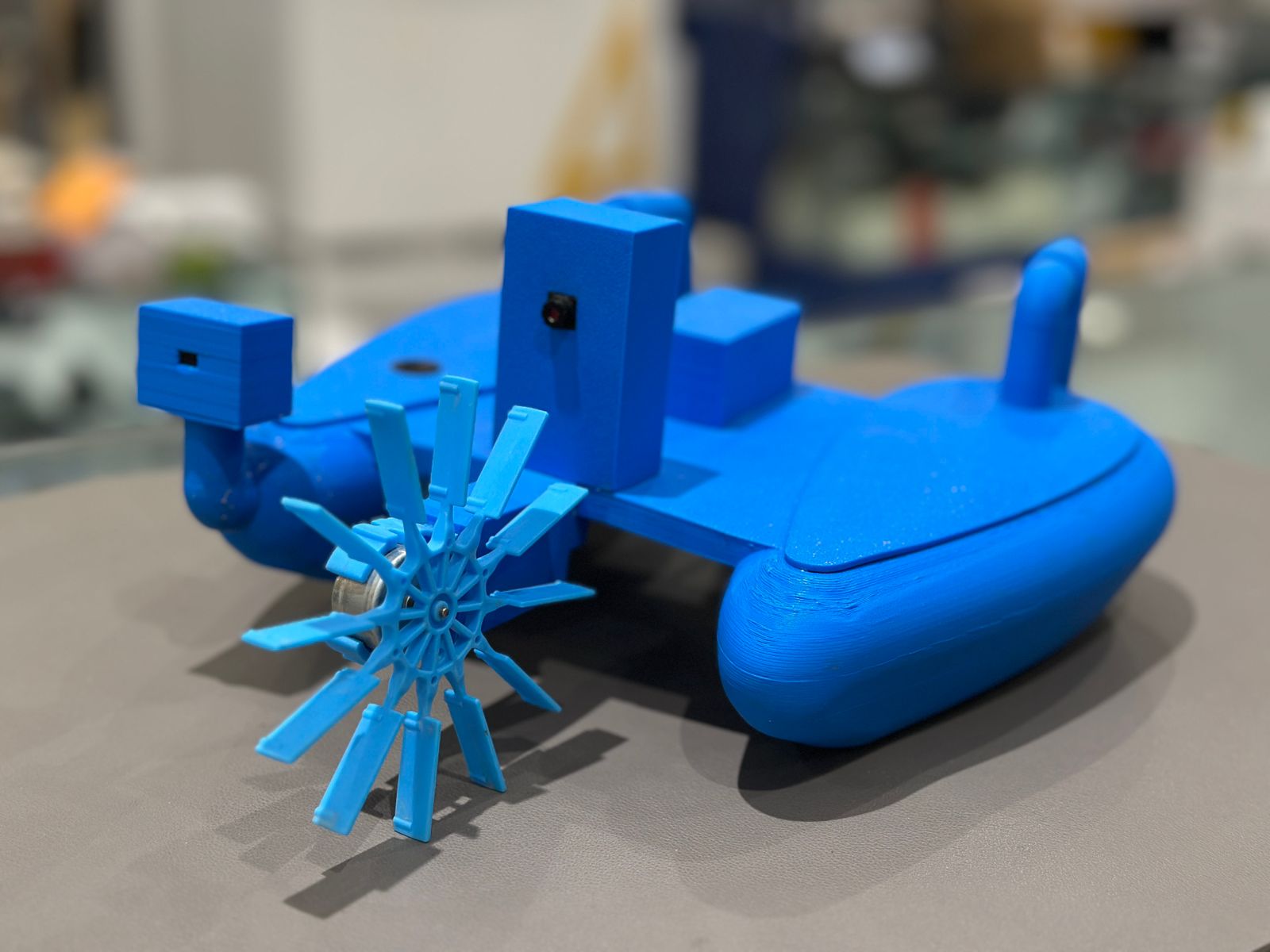
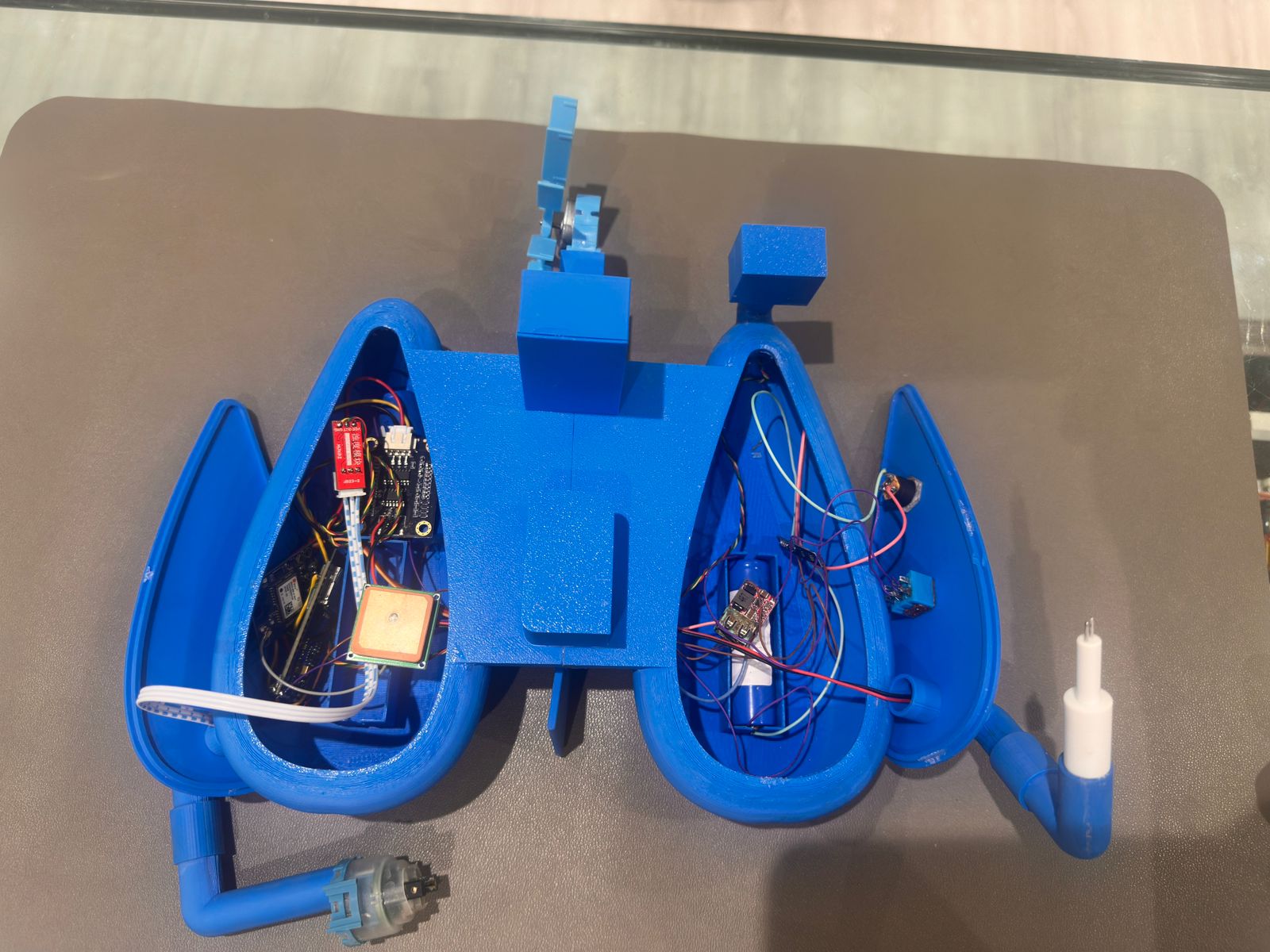
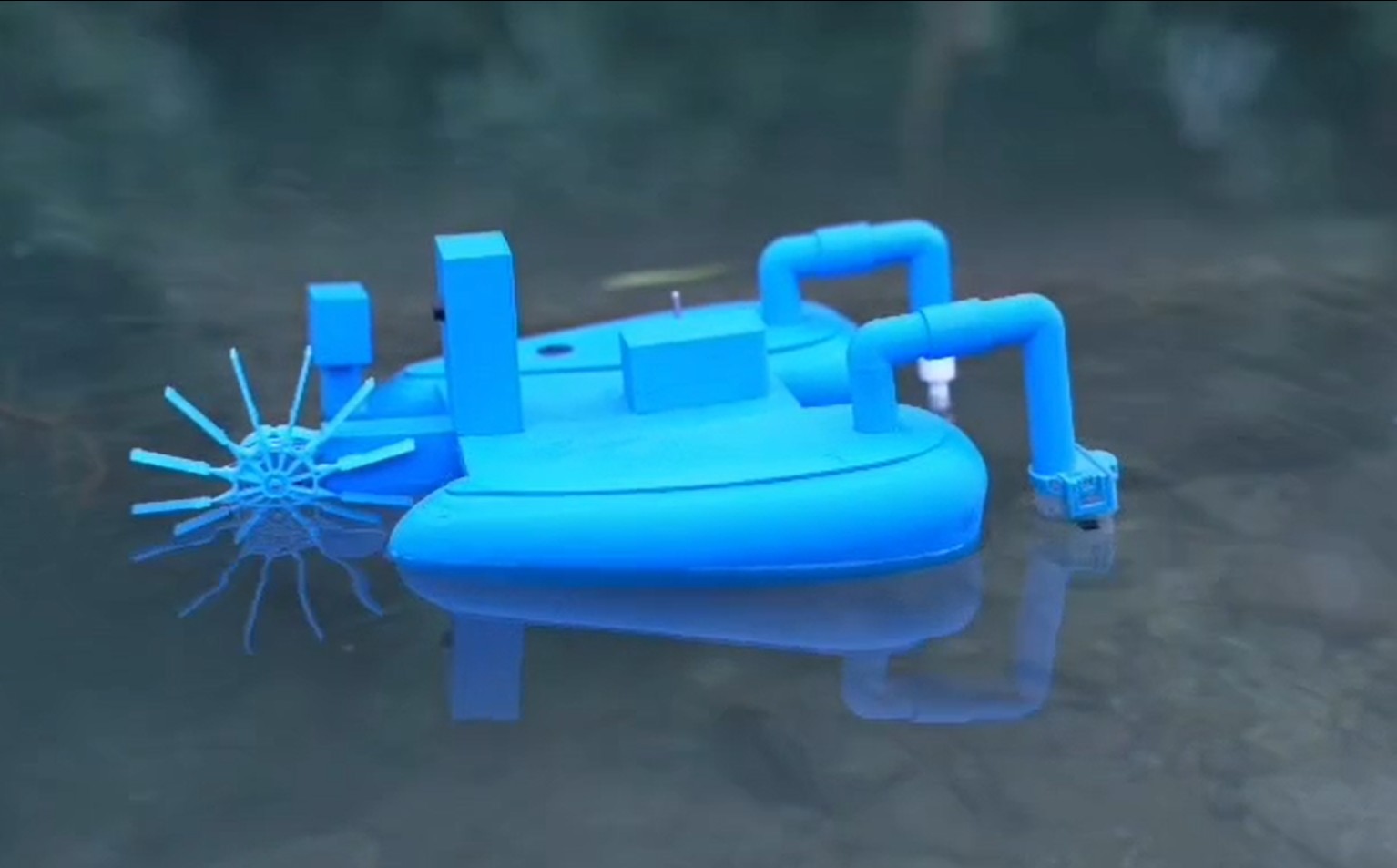
River water pollution is a grave threat to the health of the public, the integrity of ecosystems and sustainable development, especially for countries like Iraq where the Tigris River is one of the main sources of water for millions of residents. Traditional monitoring methods based on manual sampling are labor-intensive, spatially limited and lack the ability to acquire spatiotemporal data in real time. In this paper, we present Tigris Eye, a novel low-cost autonomous surface robot (ASR) system for continuous GPS-tagged AI-powered river water quality monitoring. The system adopts a passive drift navigation strategy, where a fleet of robots passively drifts through the river current without any propulsion, but with directional control only via a bio-inspired fin rudder Each robot is equipped with an ESP32-S3 microcontroller for sensor data acquisition (TDS, turbidity, laser distance), an ESP32-CAM module for periodic visual capture, a GPS module for geotagging every reading, and a hydrokinetic waterwheel mounted at the bow to harvest supplementary electrical energy from river current. All data are sent in real-time over a secure WebSocket (WSS/TLS) to a cloud-based Node.js server hosted on Railway, where YOLOv8-based visual detection identifies floating waste, algal blooms, oil spills, and colour anomalies, and GPT-4o Vision generates structured nine-field pollution assessment reports. An interactive web-based dashboard displays live sensor readings, AI analysis results, GPS-tagged pollution maps and rudder control. The fleet deployment model, multiple low-cost units operating in parallel, guarantees a complete coverage of the river and enables source-localisation of pollutants. Field validation on the Tigris River demonstrates the system's effectiveness in detecting pollution events with sub-10-second latency.