AI-Powered Pothole Detection and Road Condition Monitoring Using Smartphone Cameras
One of the major challenges is the maintenance of roads, which directly affects traffic safety and vehicle longevity. Potholes are one of the most frequent road defects, causing accidents, vehicl…
الفريق
فريق المتميزين CS
رمز الفريق
NURAI2026-0774
المشرف
م.م.زهراء ثامر مهدي
قراءة الوصف الكامل للمشروع
One of the major challenges is the maintenance of roads, which directly affects traffic
safety and vehicle longevity. Potholes are one of the most frequent road defects,
causing accidents, vehicle damage and higher maintenance costs, especially in
developing countries. The project proposes an economical intelligent road monitoring
system that uses the camera of a smartphone attached to a vehicle to automatically
detect the potholes and send alerts to the drivers and the location to the maintenance
authorities.The proposed system uses YOLOv11x deep learning model for real-time
pothole detection. The Roboflow platform was used to collect a dataset of 4,136 road
images under various lighting conditions, road environments and camera viewpoints.
Images were manually annotated with bounding boxes and data augmentation
techniques were employed to improve generalization of the model. The trained model
was quantized to INT8 for smartphone deployment, which resulted in a smaller model
size and faster inference speed. A mobile application was built with Flutter for real
time detection and visualization. Experimental results achieved 91.9% [email protected]
with an inference speed of 8-12 frames per second on mobile devices. The results
indicate that smartphone-based pothole detection can be an effective, scalable and
cost-effective approach to road condition monitoring, leading to safer transportation
and more efficient road maintenance operations.
مسار خدمة المجتمع
Deep Learning and Transformer-Based Architectures for Iraqi Arabic Sentiment Analysis on Social Media
Sentiment analysis of dialectal Arabic, particularly the Iraqi dialect, poses significant challenges for Natural Language Processing (NLP) systems due to the informal nature, morphological comple…
الفريق
فريق تويتر
رمز الفريق
NURAI2026-0772
المشرف
م. د. سهير نوري علوان
قراءة الوصف الكامل للمشروع
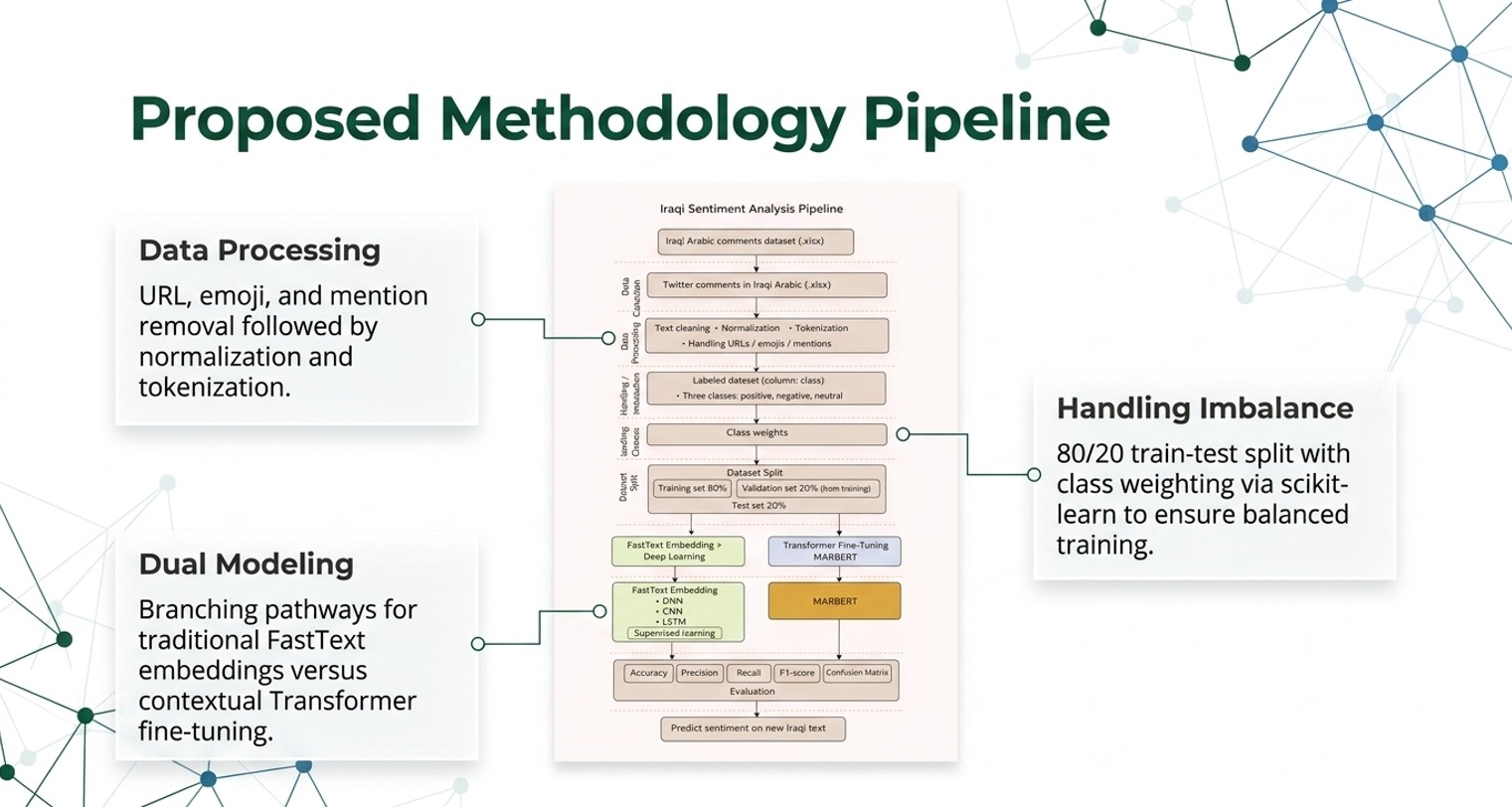
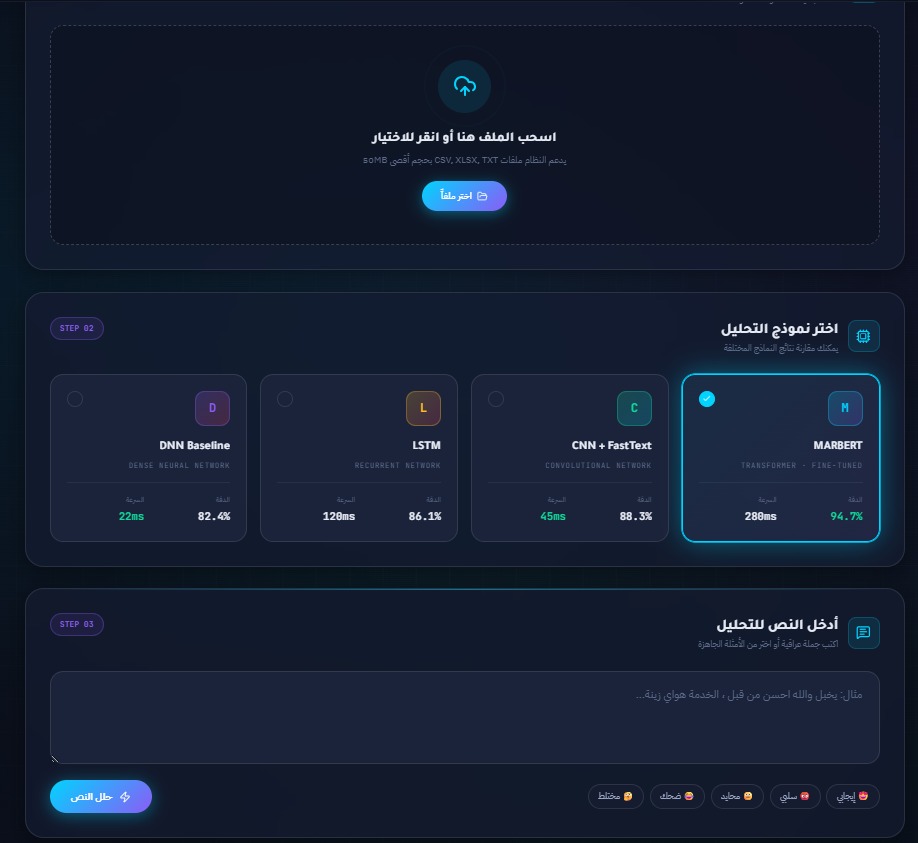
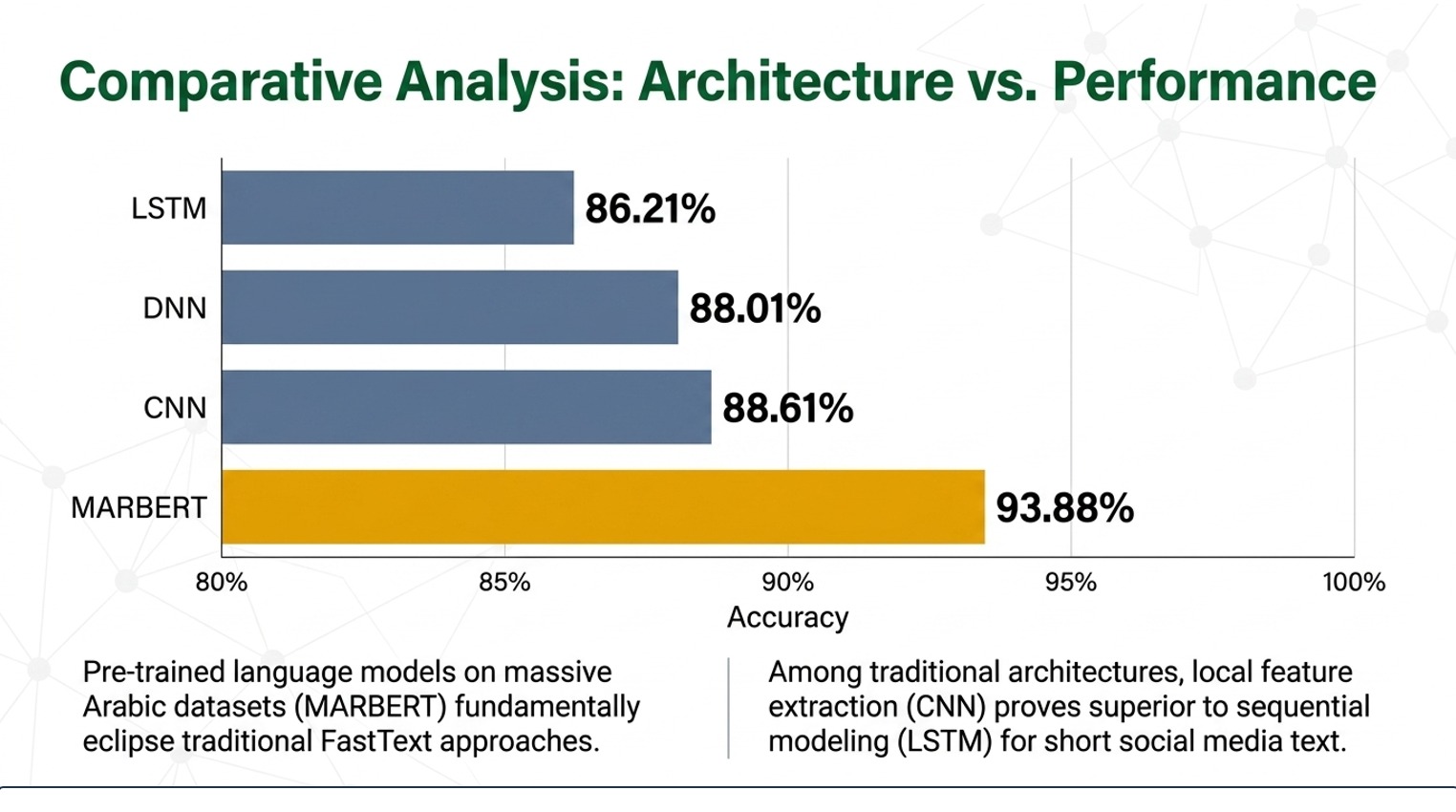
Sentiment analysis of dialectal Arabic, particularly the Iraqi dialect, poses significant challenges for Natural Language Processing (NLP) systems due to the informal nature, morphological complexity, and scarcity of annotated resources for this language variety. This project proposes a comprehensive two-track deep learning approach to classify Iraqi Arabic social media text into positive, negative, and neutral sentiment categories. The first track employs pre-trained FastText Arabic word embeddings with traditional deep learning architectures, namely Deep Neural Networks (DNN), Convolutional Neural Networks (CNN), and Long Short-Term Memory (LSTM) networks. The second track fine-tunes the MARBERT Transformer model, which was specifically pre-trained on large scale Arabic social media data. A manually annotated dataset of 4,177 Iraqi Arabic tweets was compiled and subjected to a rigorous dialect-specific preprocessing pipeline. Experimental results demonstrate that MARBERT achieves the highest performance with an accuracy of 93.88% and a macro-F1 score of 93.89%, significantly outperforming all FastText-based baselines. Among the traditional models, CNN yields the best results with 88.61% accuracy, followed by DNN at 88.01% and LSTM at 86.21%. These findings confirm that domain-specific Transformer models are highly effective for dialectal Arabic
sentiment analysis
المسار الطبي
Implementation of a Voice Controlled Intelligent Robotic Prosthesis Hand
Project Comprehensive Description 1. Problem Statement Upper-limb amputees and individuals with neuromuscular disorders often rely on prosthetic devices to regain a degree of functional independe…
الفريق
صدى الأنامل
رمز الفريق
NURAI2026-0767
المشرف
د. احمد محمد احمد الخزار
قراءة الوصف الكامل للمشروع
Project Comprehensive Description
1. Problem Statement
Upper-limb amputees and individuals with neuromuscular disorders often rely on prosthetic devices to regain a degree of functional independence in their daily lives. However, many existing prosthetic hands are controlled using EMG signals generated by residual muscles. While this approach can be effective for some users, it may not be suitable for everyone. Patients with severe nerve damage, muscle weakness, paralysis, neurological disorders, or insufficient residual muscle activity may experience difficulty generating stable muscle signals required for reliable prosthetic control. As a result, these individuals may face limitations in operating conventional prosthetic devices and performing basic tasks such as grasping, holding, and manipulating objects. The inability to effectively control assistive devices can reduce independence, restrict participation in daily activities, and negatively impact overall quality of life.
2. Proposed Solution / Innovation
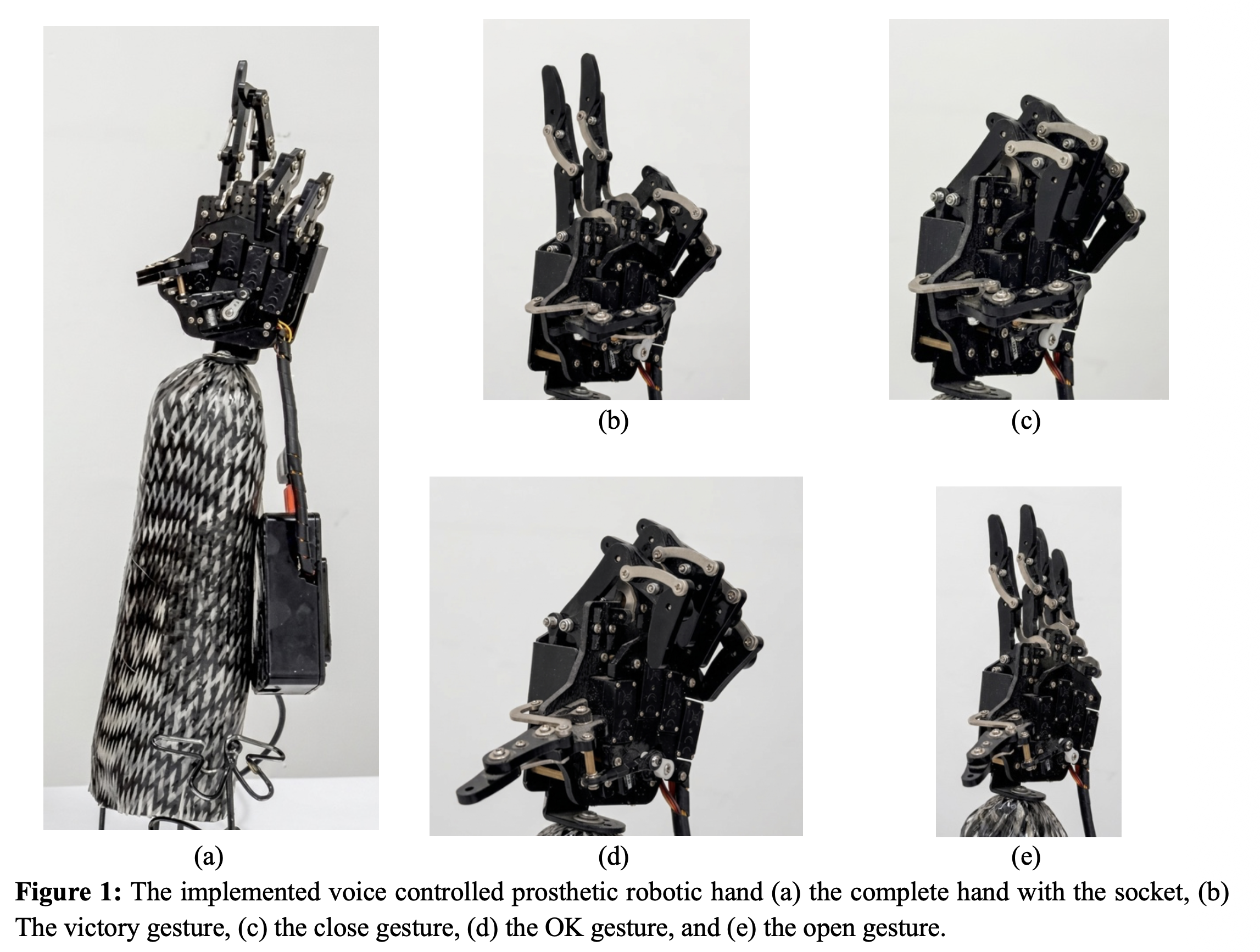
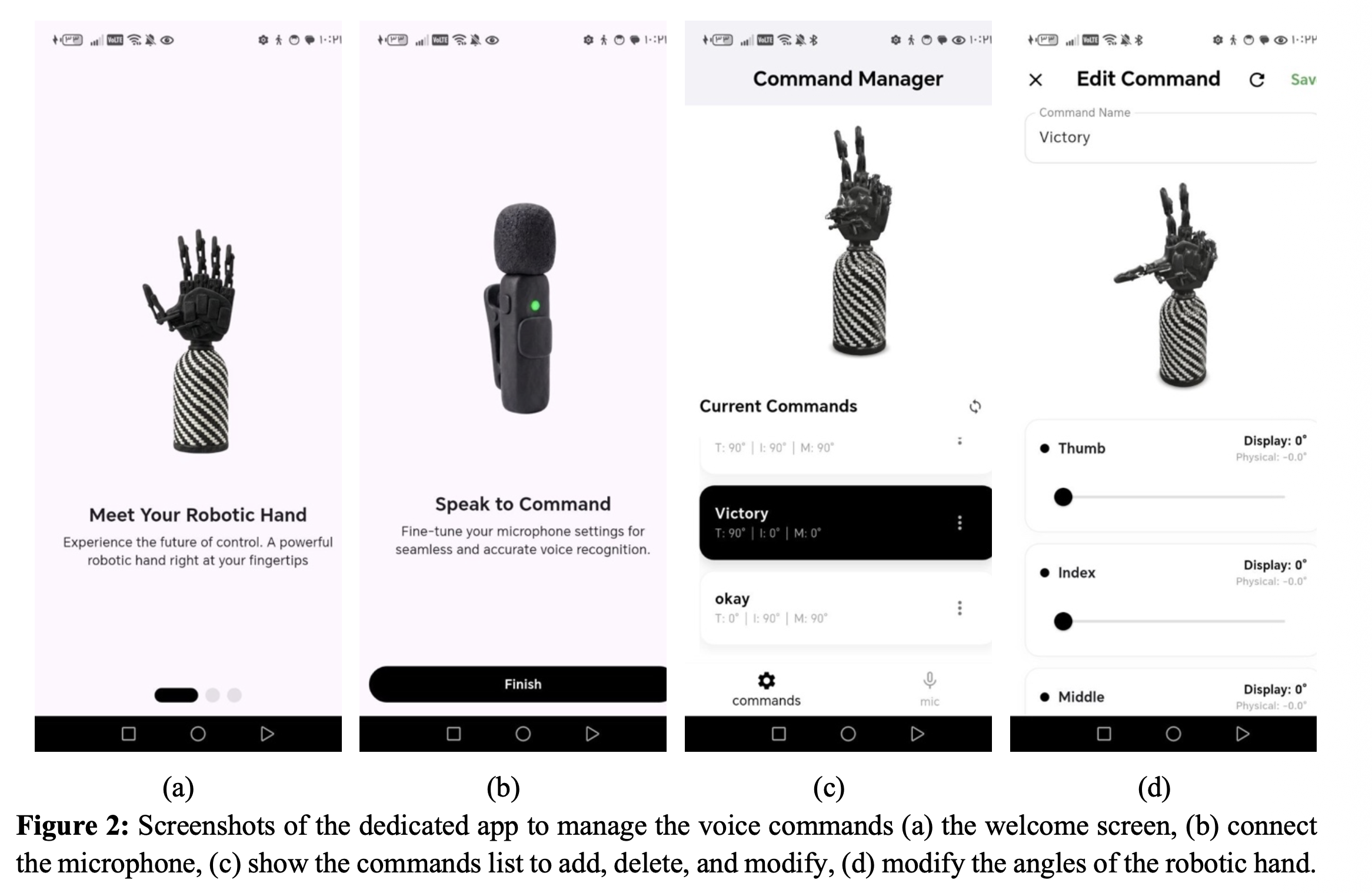
This project proposes a voice-controlled AI robotic prosthetic hand integrated with a custom-manufactured carbon socket and powered by a Raspberry Pi, utilizing the VOSK toolkit for offline speech recognition. The system operates by capturing real-time vocal inputs via a microphone connected directly to the system. The captured audio is processed offline using the VOSK speech recognition library. When a valid command is identified, the controller instantly triggers the dedicated servo motors to perform the corresponding mechanical gestures, such as opening, closing, holding, or displaying the "OK" and "Victory" signs. To enhance system flexibility, a dedicated mobile application is developed to allow the user to dynamically manage, add, or modify these voice commands.
This proposed approach effectively addresses the limitations of other active prostheses in a low-cost system and a lightweight carbon socket prosthesis. The novelty of this project lies in a smart voice-controlled robotic hand with a low-cost lightweight and robust prosthesis. Compared to existing solutions, the proposed system overcomes the EMG based problems and mitigates the training needs significantly.
3. Method / Implementation
The project is implemented through four stages:
• Requirement Analysis, where the Raspberry Pi 4B, high-torque servo motors, and the local VOSK API is selected.
• System Design, which focuses on engineering a lightweight, durable carbon socket using advanced casting alongside optimized wiring and active thermal management.
• Development and Implementation, where the five-fingered robotic hand is assembled, its actuators are mapped to the GPIO pins, the VOSK speech recognition software (utilizing MFCC, PLP, and TDNN models) is developed, and a dedicated mobile application is built for dynamic command management.
• Testing and Evaluation, where the fully assembled system is successfully verified using actual voice commands like open, close, hold, OK, and victory, with continuous software refinements to drastically reduce latency and maximize physical gesture accuracy.
4. Key Components (HW/SW/AI)
• Hardware (HW): Raspberry Pi 4B (Central Unit), MG996R Servo Motors (Actuators), and a USB Microphone (Input).
• Software (SW): VOSK API, Python 3.x, Linux-based Raspbian OS, Flutter application framework, and Dart programming language.
• Artificial Intelligence (AI): VOSK API selected since it utilizes advanced MFCC (Mel-Frequency Cepstral Coefficients) and PLP (Perceptual Linear Prediction) audio feature extraction and TDNN (Time Delay Neural Network).
5. Expected Results / Impact
• Results: The implemented voice-controlled prosthetic hand demonstrated encouraging results, successfully executing five essential gestures ("open", "close", "hold", "OK", and "victory") with quick, precise mechanical transitions supported by a lightweight, durable custom carbon socket. Powered entirely offline by a standard 5V rechargeable lithium battery, the system relies on the VOSK toolkit to deliver rapid, real-time speech recognition, seamlessly translating vocal inputs into immediate actuator movements. Furthermore, the accompanying mobile application connects wirelessly to the controller, enabling the user to dynamically add, modify, or delete custom voice commands that the system remembers and executes instantly without requiring an internet connection.
• Impact: The project empowers individuals with limb impairments by providing an intuitive, hands-free interface. It enhances autonomy and psychological well-being by offering a high-tech smart prosthesis.
6. What the 70-second Video Demonstrates
The video shows the implemented voice-controlled prosthetic hand and the developed app in action:
• Demonstration: The user issues live vocal commands such as open, OK Sign, and victory, and the prosthetic hand performs the required gestures. Then the developed companion app is shown, which can connect to the prosthetic hand and allow users to add, edit, and delete hand gestures, in addition to recording new voice commands.
• Validation: Upon issuing a voice command, the robotic hand executes these movements in real-time, demonstrating the efficiency of the AI model (pre-trained/offline) and the reliability of the mechanical assembly under actual operating conditions.
NURAI · 2026
المسار الصناعي
SERHAT: A Real-Time Dual-Stage Acoustic Leak Detection and Localization System with Physics-Informed Learning and Federated Edge Intelligence
"SERHAT is an intelligent autonomous pipeline inspection system designed to address the critical safety and economic hazards of undetected gas leaks. By deploying a dual-stage AI pipeline—utilizi…
الفريق
أمان الطاقة
رمز الفريق
NURAI2026-0769
المشرف
م. د. ايلاف عادل عباس
قراءة الوصف الكامل للمشروع
"SERHAT is an intelligent autonomous pipeline inspection system designed to address the critical safety and economic hazards of undetected gas leaks. By deploying a dual-stage AI pipeline—utilizing a Convolutional Neural Network (CNN) for real-time acoustic classification and a Physics-Informed Neural Network (PINN) for precise spatial localization—the system provides a reliable, noise-resilient alternative to traditional manual inspections. Beyond standard detection, SERHAT pioneers five engineering innovations, including Active Noise Isolation, predictive 'PRE_LEAK' metal fatigue identification, and privacy-preserving Federated Edge Learning, enabling collaborative model evolution across robotic fleets without transmitting raw audio data. Deployed on an edge-computing robotic platform, SERHAT delivers production-ready pipeline monitoring with 93.6% classification accuracy and 0.31m localization precision, ensuring operational safety and environmental integrity."
المسار الصناعي
الكشف الآلي عن الأعطال وتصنيفها وتحديد موقعها في الحقول الشمسية باستخدام التعلم العميق والذكاء الاصطناعي
تُعدّ الطاقة الشمسية الكهروضوئية من أسرع تقنيات الطاقة المتجددة نموًا على مستوى العالم، إلا أن كفاءة وموثوقية هذه الأنظمة تتأثر بشكل كبير بالأعطال المختلفة، مثل تراكم الغبار، والتظليل الجزئي، وال…
الفريق
القدرة والتحكم
رمز الفريق
NURAI2026-0768
المشرف
أ. د. علي عبد الرزاق عباس الطاهر
قراءة الوصف الكامل للمشروع
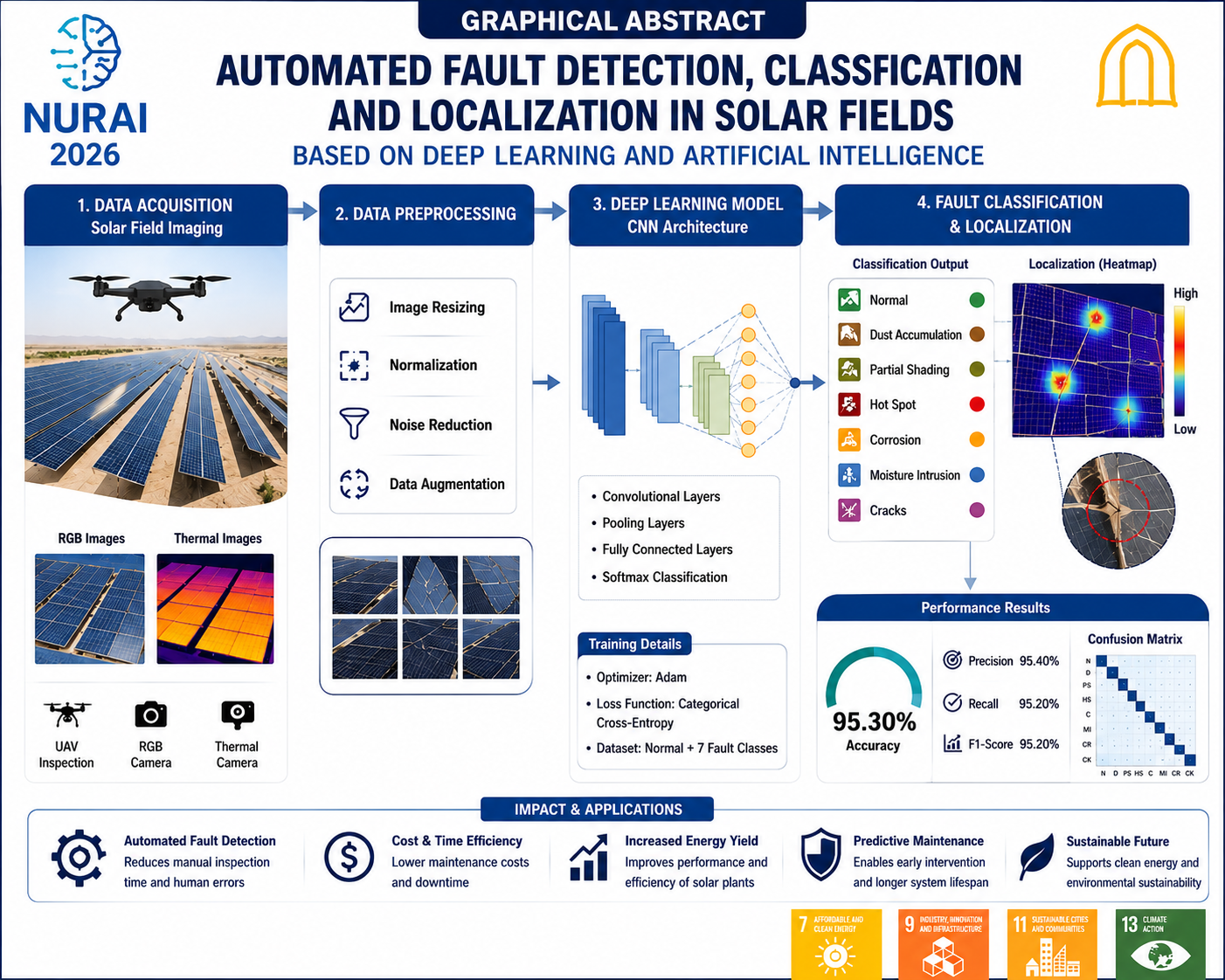
تُعدّ الطاقة الشمسية الكهروضوئية من أسرع تقنيات الطاقة المتجددة نموًا على مستوى العالم، إلا أن كفاءة وموثوقية هذه الأنظمة تتأثر بشكل كبير بالأعطال المختلفة، مثل تراكم الغبار، والتظليل الجزئي، والبقع الساخنة، والتشققات، والتآكل، وتسرب الرطوبة، وأعطال الثنائيات، والتي تؤدي إلى انخفاض إنتاج الطاقة وارتفاع تكاليف الصيانة. يعالج هذا المشروع تحدي الكشف الآلي عن الأعطال وتصنيفها وتحديد مواقعها في حقول الطاقة الشمسية الكهروضوئية من خلال تطوير نظام مراقبة ذكي يعتمد على الذكاء الاصطناعي والتعلم. يعتمد الحل المقترح على استخدام الشبكات العصبية الالتفافية) لتحليل الصور المرئية والحرارية الملتقطة للألواح الشمسية، مما يتيح التعرف التلقائي على أنواع متعددة من الأعطال وتصنيفها وتحديد مواقعها بدقة عالية. ويهدف المشروع إلى تحسين موثوقية وكفاءة تشغيل محطات الطاقة الشمسية، وتطوير عمليات الصيانة من خلال تقليل الاعتماد على الفحص اليدوي، وخفض زمن اكتشاف الأعطال، وتقليل التكاليف التشغيلية. وقد أظهرت النتائج التجريبية أن النموذج المقترح حقق دقة تصنيف بلغت 95.3%، مما يؤكد كفاءته في التشخيص الذكي للأعطال. كما يوفر النظام إطارًا عمليًا وقابلًا للتوسع لدعم المراقبة الآنية، والصيانة التنبؤية، مع إمكانية التكامل مستقبلًا مع الطائرات المسيّرة وتقنيات إنترنت الأشياء. ومن خلال تعزيز قدرات تشخيص الأعطال وتحسين استراتيجيات الصيانة، يسهم المشروع في تطوير أنظمة إدارة ذكية للطاقة المتجددة ودعم التشغيل المستدام لمحطات الطاقة الشمسية الكهروضوئية واسعة النطاق
NURAI · 2026
المسار البيئي
نظام ذكي للكشف عن الروائح باستخدام تقنية الذكاء الاصطناعي
تعتمد الطرق التقليدية للكشف عن الروائح وتحديدها بشكل كبير على التقييم البشري الذاتي أو على معدات مختبرية باهظة الثمن، مثل كروماتوغرافيا الغاز – مطيافية الكتلة (GC-MS)، والتي غالبًا ما تكون غير عم…
الفريق
فريق الابتكار
رمز الفريق
NURAI2026-0770
المشرف
د.مها صبري التميمي
قراءة الوصف الكامل للمشروع
تعتمد الطرق التقليدية للكشف عن الروائح وتحديدها بشكل كبير على التقييم البشري الذاتي أو على معدات مختبرية باهظة الثمن، مثل كروماتوغرافيا الغاز – مطيافية الكتلة (GC-MS)، والتي غالبًا ما تكون غير عملية للتطبيقات الميدانية في الوقت الحقيقي. يقدّم هذا البحث نظام الكشف الذكي عن الروائح، وهو جهاز محمول ومنخفض التكلفة يدمج مصفوفة حساسات غازية متعددة مع ذكاء اصطناعي مُدمج لتصنيف الروائح في الوقت الحقيقي. يجمع العتاد بين ثلاثة حساسات متكاملة تقيس درجة الحرارة والرطوبة ومجموعة من الغازات تشمل أول أكسيد الكربون (CO) وثاني أكسيد النيتروجين (NO₂) والإيثانول والمركبات العضوية المتطايرة (VOCs)، وهي متصلة بوحدة تحكم دقيقة من نوع Seeed Wio Terminal. يستخدم النظام مسارًا للتعلم الآلي يجمع بين شبكة عصبية ضحلة للتصنيف الدقيق وخوارزمية التجميع K-means لكشف الشذوذ، مما يمكّن الجهاز من تمييز الروائح المجهولة بدلًا من إجبارها على تصنيف خاطئ. تُظهر النتائج التجريبية دقة اختبار تبلغ 99.74% عبر ثلاث فئات تمثيلية هي الكحول والبنزين والهواء المحيط، مع زمن استدلال يبلغ نحو 2 مللي ثانية وبصمة ذاكرة لا تتجاوز 1.6 كيلوبايت من ذاكرة RAM و20.4 كيلوبايت من ذاكرة Flash. تؤكد هذه النتائج الجدوى العملية لنشر نظام استشعار كيميائي مستقل وعالي الدقة على وحدات تحكم دقيقة محدودة الموارد لتطبيقات في مجالي السلامة الصناعية والمراقبة البيئية.